Wassup, Traipser! Dakota here with my newsletter about creativity, travel and living an intentional life, which I started years ago when quill pens were more popular than iPhones. I didn’t use AI to write then and I still don’t! (Please forgive typos.)


Speaking of AI, this week this newsletter dives into:
If/when to use AI.
The enshittification of the internet thanks to AI.
A take on the magic of being human.

To kick things off, something to keep in mind and ponder from the excellent book How to Know a Person:
The Lesser-Minds Problem:
In day-to-day life we have access to the many thoughts that run through our own minds. But we don’t have access to all the thoughts that are running through other people’s minds. We just have access to the tiny portion they speak out loud.
This leads to the perception that I am much more complicated than you—deeper, more interesting, more subtle, and more high-minded.

In case you missed it: Last time I wrote about our trip so far…
Eight months on the road!

Eight months! While we’d done a dozen tester trips in the trailer before this long one, we weren’t sure how months and months would go.
Good old human power
Call me old-school, but I want my friends to message or email me without using AI.
Yup, crazy, I know: I prefer to hear actual words from the actual brains of people in my life! Give me unadulterated, messy, awkward, comma-splice-filled communications with zero therapist speak.
And yet, like many people, I’m also using generative AIs like Claude. This week, it helped me research health insurance plans, campgrounds on Vancouver Island, and a tricky formula with Google Sheets (a task it failed, I should add).
I also occasionally wonder whether the robots are going to turn us into sacks of goo in the Matrix.
After experimenting, I’ve drawn a line for myself for how I use it: never with creative pursuits or for communication. I think of it as just another tool, not to be used mindlessly in every situation. Sure, I can use a chainsaw, but I don’t carry one into grocery stores.
An excellent distinction is found in this essay from Daniel Miessler, an AI researcher who talks about whether it’s for a job or the gym:
If we’re working a manual labor job, it’s fine to have AI lift heavy things for us because the actual goal is to move the thing, not to lift it.
This is the exact opposite of going to the gym, where the goal is to lift the weight, not to move it.
I lift weights and suffer through planks not just to workout, but to be capable in other arenas of my life that require fitness. Same thing with writing and thinking.
Yeah, one could claim the written word is dying…but I for one don’t write merely to communicate.
As I wrote over a decade ago, twenty minutes of typing is physical thinking that sorts out the wrinkled, jumbled mess in my skull like smoothing out a crunched up ball of paper. I have hundreds of unpublished essay drafts that refined my thoughts, but never saw the light of day.
Anyway…pffft, writing? “Bro, forget writing: imma be an influencer and just make videos!”
Uh, sure…but how are you going to put together a coherent script or organize your ideas. You just gonna pick up a camera and start talking to it? Fascinating idea. No market competition there, Adam Smith…
I’ll concede we may need fewer writers in the future (technical writers, for one). But there’s a reason teachers continue to assign writing assignments in the age of AI: Writing develops critical thinking, problem solving, or creating arguments for or against a given position, skills humans will continue to need for the foreseeable future.
Regardless, please do not give me a world where our AI agents send happy birthday greetings and also respond to them, then generate a summary of who messaged whom for our AI management agent to tally up. May I never get a life update email or holiday letter from a friend’s AI assistant based on their device listening to everything they do, then reporting it.
At the end of the day, I’m more in line with the wise Oliver Burkeman and his latest almost-rant, Let’s stop talking about AI.
“We have lives to live, people! Lives immeasurably fuller and more interesting than can be dreamt of in Silicon Valley’s ideology. Lives that encompass vastly more than what software can do.”
Hear, hear!


The Shape of Enshittification
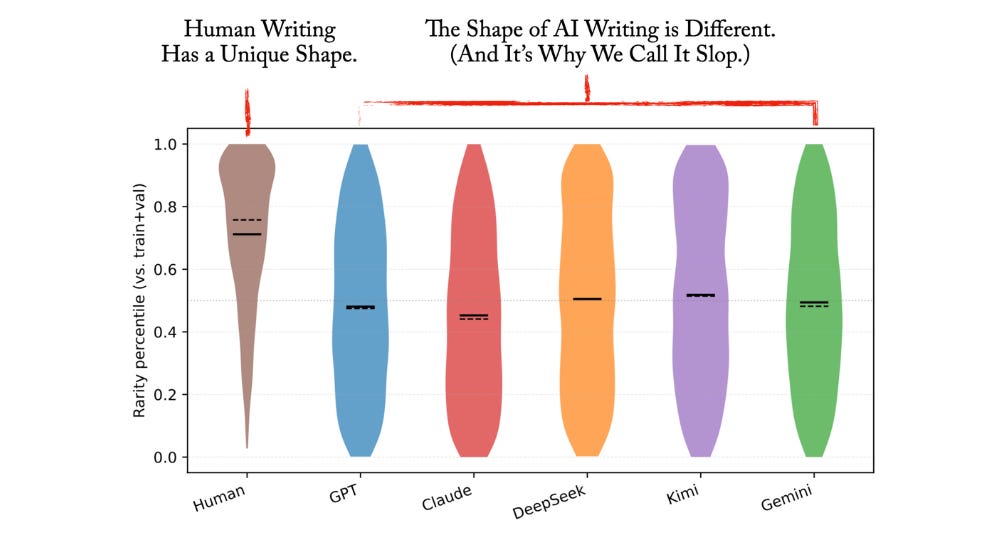
Meanwhile, the internet’s enshittification continues. Researchers at the University of Maryland and Google DeepMind ran a study looking at human writing vs. AI. Based on that, they found five distinct ways that the shape of human writing is decidedly different from the so-called slop generated by today’s AI models:
AI over-explains its themes. (instead of letting readers infer)
Human writing is less linear. (more time-jumps and flashbacks.)
AI relies on bodily metaphors to explain emotion (81% vs. 38% human)
Humans reference specific texts, brands, places (nearly 2x the AI rate)
AI narrative is less diverse (fewer subplots and scenes, less dialogue)
(From the essay The Shape of Enshittification.)

Please use AI
This bookshop owner nails it with the poem Please Use AI. One of the most (dare I say) human pieces of writing I’ve encountered recently. I implore you to read the short piece, but here’s a good sample:
Be sure to use AI when your next child
gets married, so that you can write them
the perfect toast or poem or speech or song
because no one wants to hear your
words, the actual poorly written words
of a parent (you) who changed
hundreds of diapers for said child or fed
them in the middle of the
night from your actual body. Or cried
when they were late home because
you were positive they were dead. We don't
want those words—we’d prefer the sterile
words of a machine that never lived, never
had an original thought, never felt
the pain of miscarriage or broken
relationships or the joy of a friendship restored
or of seeing spring’s first
robin dancing on frost.
Hell. Yeah. Really, go read the entire thing!


Traipsing About is hiding out from summer heat on an island, but I leave you with this parting thought:
“The danger is that if we invest too much in developing AI and too little in developing human consciousness, the very sophisticated artificial intelligence of computers might only serve to empower the natural stupidity of humans.”
-Yuval Noah Harari, 21 Lessons for the 21st Century (←great book)
Onward,
Dakota