
Tracing my roots in Sant'Agata di Puglia
A mother-son trip to my great-grandfather's Italian village.

Wassup! Dakota here with Traipsing About, my AI-free newsletter (I get credit for all typ0s and digressions). In it, I explore living an intentional life while reclaiming creativity as an adult, spiced up with my travel experiences, pictures and daily drawings.
Thank you for being here. I appreciate your time and attention in these information-overloaded times.
In case you missed it: Last time I wrote about kicking off a month-long trip to Italy with some solo time exploring Rome. More to come about my trip!

Digging for Italian roots
If I wrote a screenplay about me and my mom returning to her grandfather Annibale’s Italian village, it would feature random encounters with relatives, a hill town, classic Italian music (cue accordions!), old guys in piazzas, and pizza in the same piazzas.
Not very creative, right? Cheeseball!
Well, red line my first draft and tear up the second because that’s exactly what happened when we visited Sant’Agata di Puglia. As the magical moments stacked up during our four-day visit, I kept expecting to see hidden camera lenses jutting out from secret enclosures, Truman Show style.
Instead, it was just me, the Paparazzi Figlio, following my mom around during our first mother-son road trip.
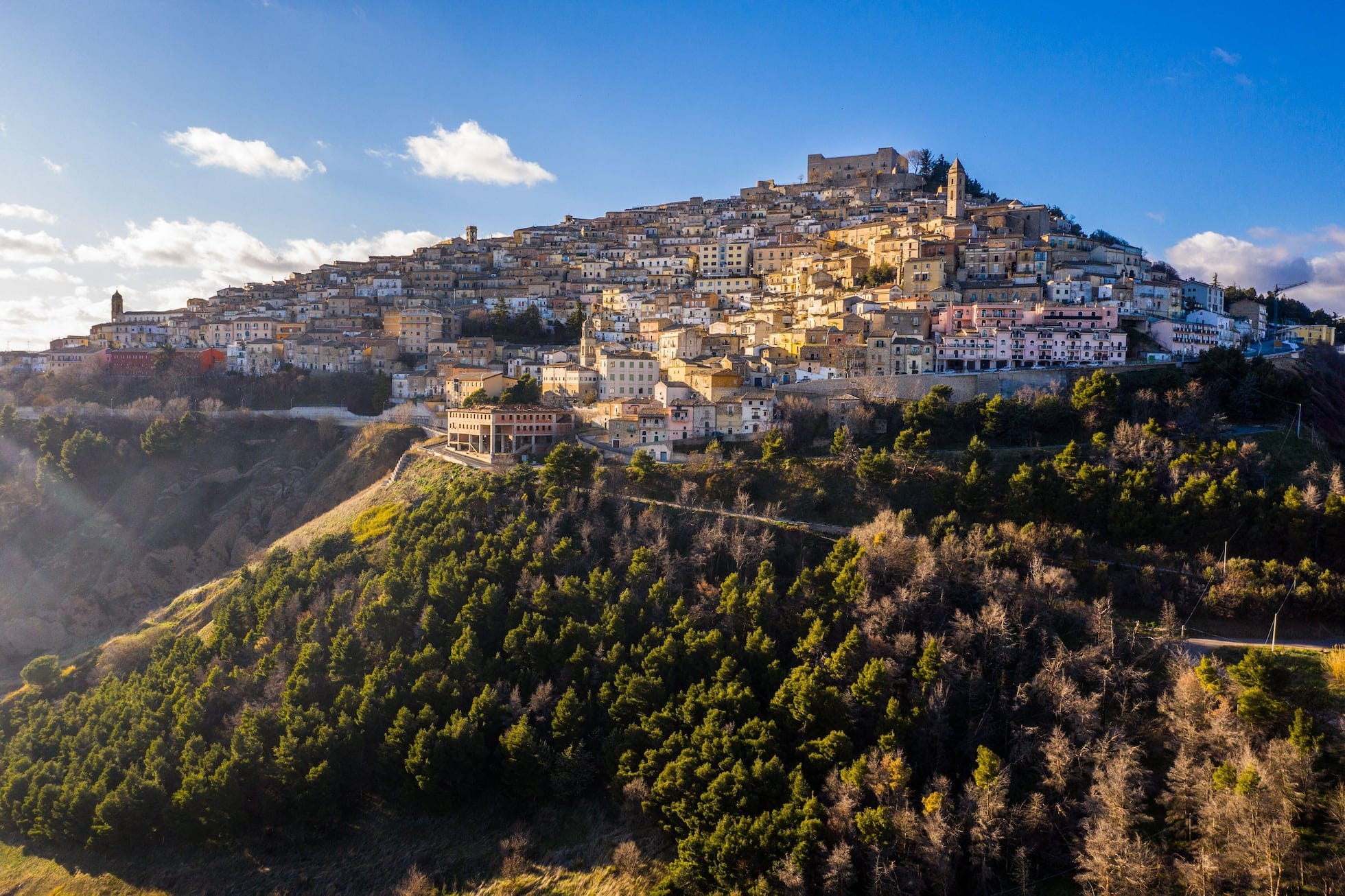
The quintessential Italian hill town
Driving up the steep hill into Sant’Agata, my mom spotted a statue of the Madonna on the side of the road. I was hangry and late for our arranged check-in, but I pulled over anyway. She started gesturing for me to get out...well look at that, the statue was commissioned by Lucia Marchitelli, one of our relatives!
Our charmed visit to Sant’Agata di Puglia was underway.
My great-grandfather was born in Sant’Agata in 1879, then left 27 years later in pursuit of a better life in America. Through his lineage, I was able to acquire Italian citizenship for me, my siblings, and my mom. I’d learned the language (very necessary for this visit, as it turned out!) and we’d talked about visiting the village together ever since to close the loop.
Home for our stay: L’Antico Monastery, a 500-year-old Catholic monastery restored in brilliant fashion as a hotel. Original marble floors, classy decor, delicious breakfasts, and expansive countryside views were the perfect base for our stay in the town.


The serendipity came at us fast. During our first evening, my mom said (in Italian) to the first woman we passed on the streets, “I’m a Marchitelli. Do you know any?” The lady did a doubletake, said “But...I’m a Marchitelli!”
We’d just met a cousin, Fiorina. After a warm conversation, she hugged us, telling me “Ti abbraccio come un figlio” (I embrace you as a son).
A few steps later, we found ourselves in the piazza in the center of town overlooking the green hills. It was full of people, including young boys kicking soccer balls, old guys strolling back and forth in a line, parents with strollers, and a line of guys sitting on a bench near the edge.
One of them had a boombox, which was playing Funiculì, Funiculà, the famous Italian tune. My mom was radiant, just soaking in the energy, and the men grinned as she spontaneously sang and danced to the music. I checked for hidden cameras; surely this scene wasn’t real.
Shortly after, we chatted with a group of people standing outside a pizzeria. One of them, Rocco, had grown up in Sant’Agata and had a career at the local Fiat factory. He was a huge fan of Harley Davidson motorcycles and had ridden them all over Europe. Hearing that we were searching for Marchitellis, his eyes brightened and he said, “follow me!”
Down the narrow main street we went, ducking into doorways whenever a car passed the definitely-not-designed-for-cars cobbled lane. A few hundred feet down the road, Rocco pointed to a doorway. Above it, faintly etched in the stone, was an emblem and the words MARCHITELLI, 1849.
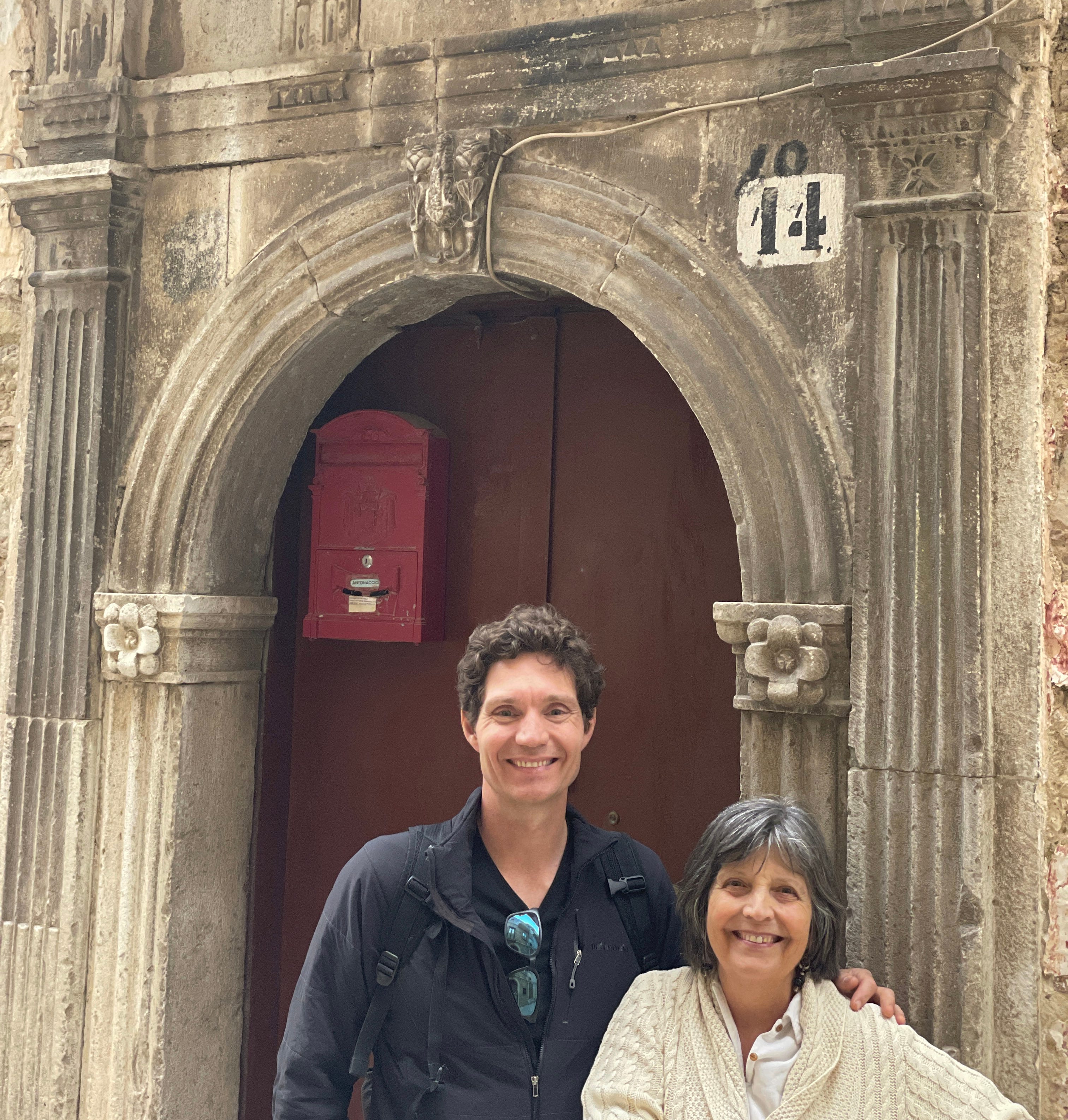
Finally, the pizzeria opened. (7:30 pm; how many times did the hunger monster hit me at 6:30 in Italy when everything was closed?!) Like many of the buildings in the town, the restaurant was built into the raw rock of the hill, almost cave-like.
Inside, a kids’ birthday party was raging. And I do mean raging: the parents lounged in the back of the pizzeria chatting while the kids rampaged around, eating an occasional french fry to refuel their engines before spinning in circles again.
We were beat after a full day, so back to the monastery we went to sleep like monks, but on soft, comfy beds.


Chasing the Marchitellis
For our first full day in Sant’Agata, we started off with a marvelous breakfast at the monastery. Vegan croissants and yogurt for me, plus the local offering of crusty bread with tomatoes and olive oil. I, No Coffee Guy, even drank a sugary cappuccino.
First stop that morning: ancestry research at the municipality office. Our fixer, Rocco, met us at the office.
There, the employee pulled out the giant paper registry where all the town’s births were recorded. Hey, there’s Marchitelli scribbled in fine Italian script from 1879, along with a description of the address!
After a few minutes of debate and magnifying glasses, the guy and Rocco decided that the address read “la traversa sotto la piazza,” so we were off to find my great-grandfather’s house on the path below the square.
And there it was, THE Marchitelli property, the start of my mom’s side of the family.


Later, my mom and I explored the city and stumbled upon a little weedy plaza dedicated to Gino Marchitelli, another cousin. He’d documented the local Sant'Agatese dialect by interviewing farmers and townspeople over a seven-year period, creating a 7,000-word dictionary.


Speaking of the dialect, later I asked Rocco to demonstrate it. He said a sentence of about 10 words in Italian; I understood him perfectly. Then he said it in dialect. I only understood one word! The local is similar to Neapolitan, which isn’t even considered Italian by linguists—it’s classified as another language.
Another time, we explored the beautiful church in town. My mom spent a long time sitting and thinking about her mom, my wonderful Italian grandmother who always asked if I’d gone to Easter Mass. (Sorry Grandma!)


How did this little town of 1,700 people afford such a big, fancy church? I suppose decades and decades ago, when the town’s population was over 10,000, there were a lot more resources. The population drain from Southern Italy sent millions of people to the U.S. during my great-grandfather’s lifetime, and even today young people continue to emigrate.
Case in point: a young woman at a pizzeria who said she loves Sant’Agata, but that there is no opportunity there. She’s heading to medical school in Rome, a five-hour drive north. I pictured her sweet, country personality in the cacophony of the big city, trading the familiar faces of a small town for the isolation and pressure of a metropolis.


Our third day, the skies opened up and it raiiined and rained. Over meals and hangtime in the monastery, my mom spun stories from her past. We’ve spent lots of time together over the years, but something about traveling together for the first time, especially in a distant foreign land, really dredged up her memories.
During a rain break, we headed out into town, only to get chased under an eave during a downpour. I glanced at the apartment building; well look at that, two Marchitellis on the buzzer call buttons! I was feeling brave and called Vincenzo Marchitelli, but sadly only chatted with his daughter.
My mom and I sat in a cafe and enjoyed some hot beverages as the rain hammered down outside. She shared many more stories of her time as a student in Italy 50 years ago, tales of being young and free. Rain, smain. It didn’t matter where we were or what we were doing, this was special mother-son time together.
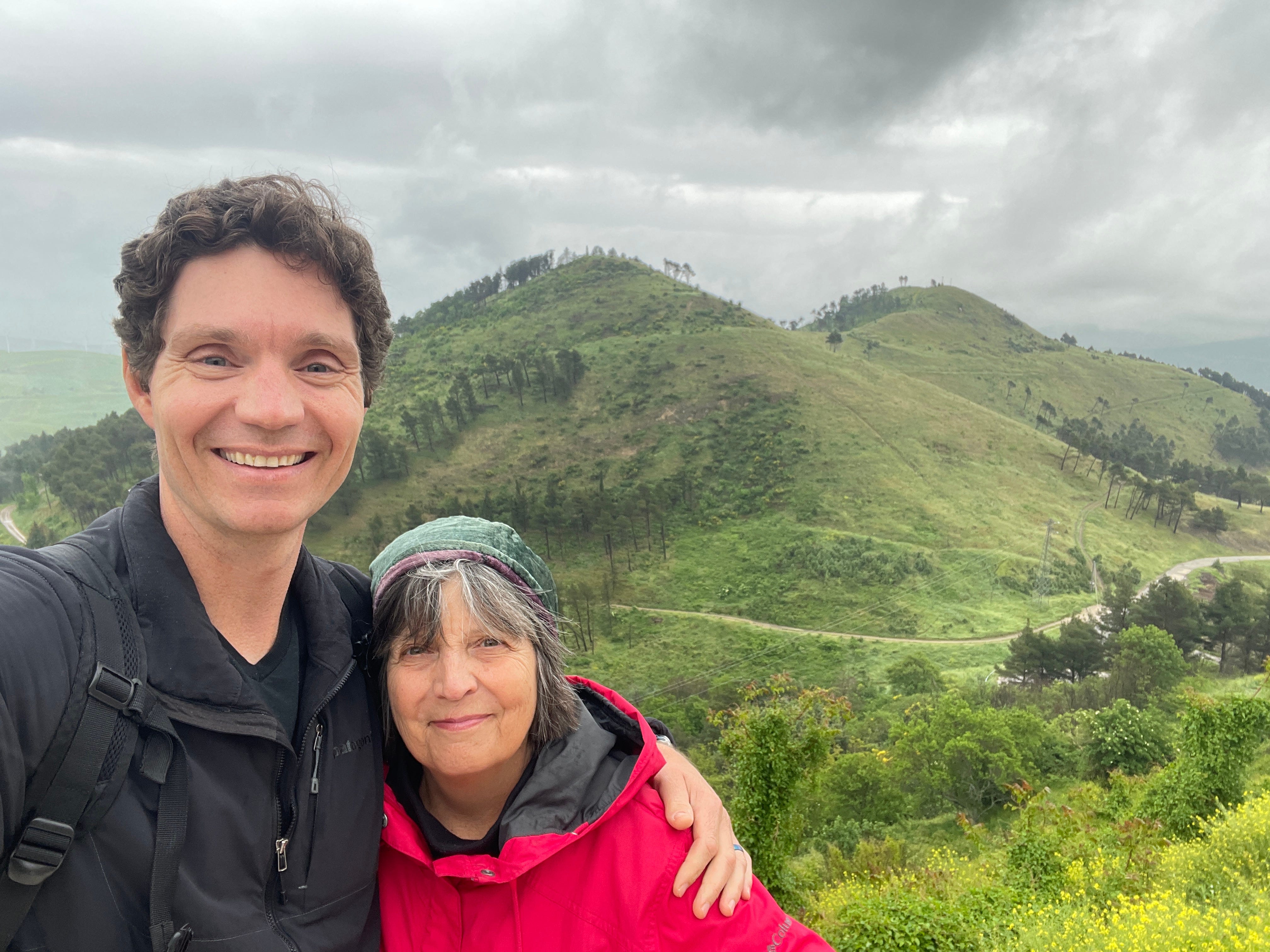
One last evening
Our final night in town, we climbed back up to the piazza. Two kids kicked a soccer ball; a line of old guys enjoyed their ritual of the evening passeggiata.
It felt timeless, the same worn cobblestones trodden by different feet over centuries. I spotted a few other familiar faces, chatted with people. Four days here and, in a small way, we already felt embraced by the community.
As night approached, I climbed solo up the narrow, steep steps of the town to the castle at the top. Standing on the wall overlooking the little town, I could hear the hum of voices from the town square far below. The hills rolled off into the distance in the evening murk.
A bolt of connection to my great-grandfather Annibale struck me. A surreal feeling, standing there soaking it all up.
Somehow, he’d journeyed from rural Italy to New Jersey. Speaking zero English and with only $11 in his pocket, he’d started a new life and family that would include my grandma.
The courage he must have summoned! To leave the thrum and tight village life in the Italian hills and bid one final arrivederci to everyone in the village square. What did it feel like to hug his parents and say goodbye (forever, as it turned out), then traverse an ocean to an unknown new life?
At that moment, the church bells started clanging away. The same bells Annibale would have heard from the day he was born to his final night in Sant’Agata way back in 1906.
That span of 120 years felt like nothing, like he could walk up to the castle and greet me. After all the magic of the visit, it wouldn’t feel out of place one bit.
The church bells stopped clanging and I headed down through town. The script to my cheesy, too-perfect movie visit to Sant’Agata was complete.
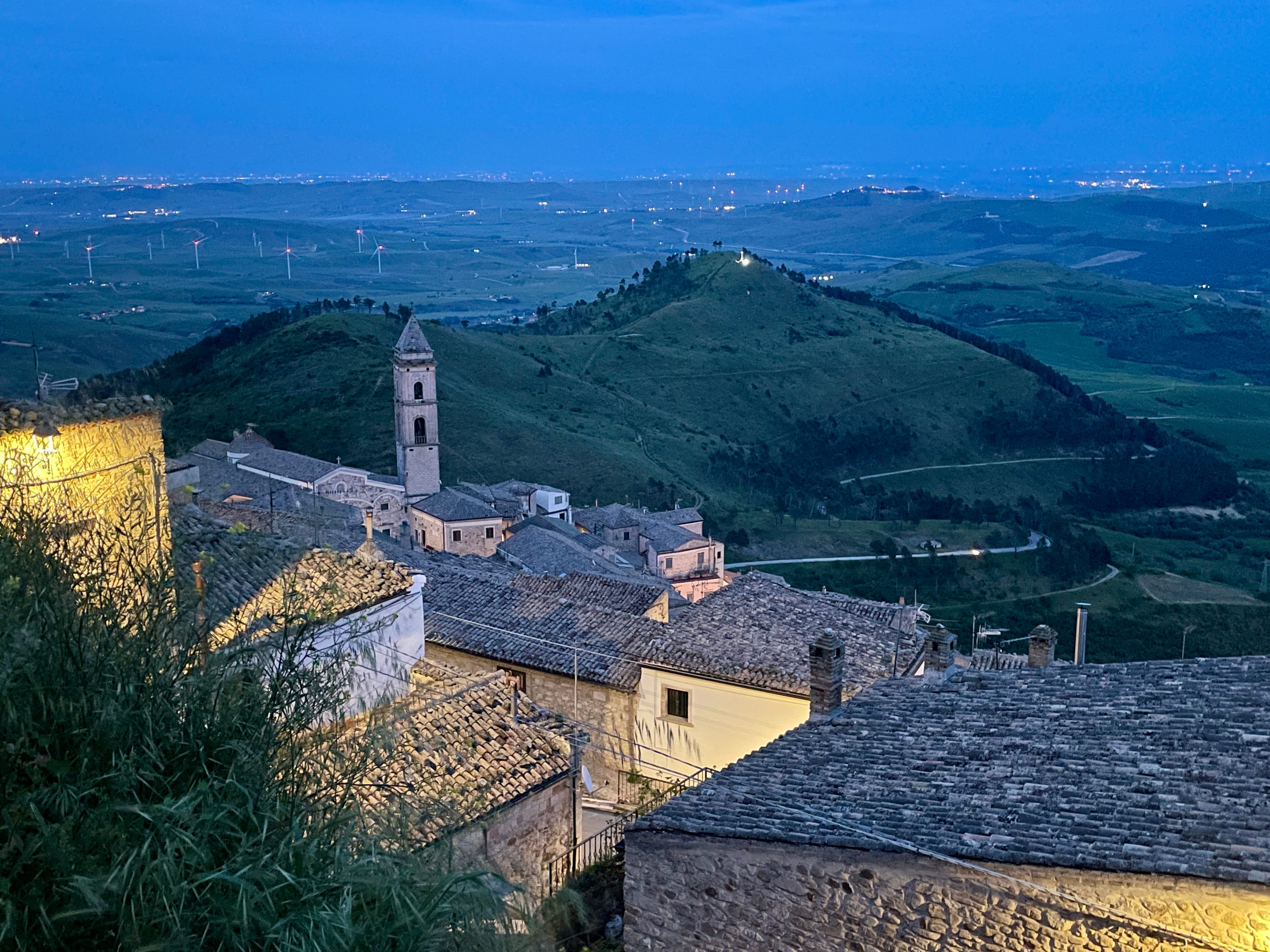
Just magical...
What a great trip!